Ember's Anti-Swipe Pitch: A Threat to Match and Bumble's Economics?
·6 min read
Match Group share price has fallen over 60% from its 2021 peak due to stagnating Tinder growth and margin compression
Bumble stock has collapsed roughly 80% since its IPO as dating app satisfaction plummets
A 2023 Pew Research study found 45% of US dating app users felt more frustrated than hopeful, up from 35% in 2019
Limited daily match formats have been attempted since Coffee Meets Bagel pioneered the approach in 2012
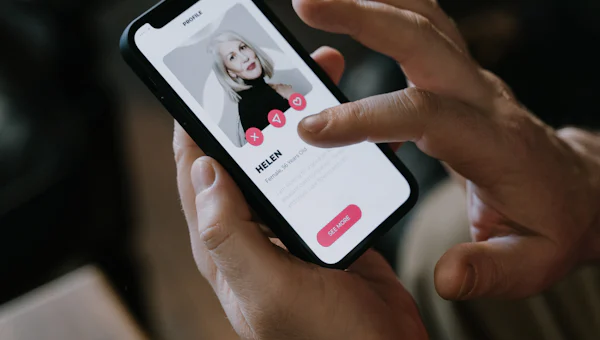
Ember Vision Ventures has entered the market with a dating app that limits users to a handful of daily matches selected by AI, becoming the latest entrant to stake its business on the idea that the swiping model is broken. The product joins a crowded field of apps promising to end swipe fatigue by restricting volume and emphasising curation over endless choice. What's more notable than the product itself is the pitch: that the engagement-maximising model which built the modern dating industry has fundamentally failed users.
If that premise gains traction with investors and users alike, it represents a direct threat to the unit economics that have sustained Match Group and Bumble for years. The question isn't whether the product is novel—it isn't—but whether challengers can finally crack the distribution and liquidity problems that killed their predecessors.
Dating app user reviewing daily matches on smartphone
The DII Take
Ember's launch isn't news because the product is novel—it isn't. Limited daily matches have been tried by Coffee Meets Bagel, Once, and a dozen others with modest results at best. What matters is that challengers are now explicitly positioning against the business model, not just the UX.
Enjoying this article?
Join DII Weekly — the dating industry briefing, delivered free.
Whether a bootstrapped newcomer can actually solve distribution and liquidity problems that killed predecessors remains the question, but the narrative they're selling—that incumbents optimised for screen time at the expense of outcomes—will resonate with regulators, investors nursing losses, and burnt-out users alike.
Repackaging a familiar promise
The core mechanics are not new. Ember users receive curated matches each day rather than infinite swipes, a format pioneered by Coffee Meets Bagel in 2012 and deployed by apps like Once, The League's daily batch feature, and Hinge's 'Most Compatible' prompt. The AI compatibility angle is similarly well-worn territory—OkCupid built its brand on algorithmic matching in the mid-2000s, and eharmony has claimed scientific compatibility systems since 2000.
But intentionality doesn't solve the cold start problem. Dating apps live or die on liquidity—the likelihood that opening the app yields viable matches. Restricting volume only works if the curation is meaningfully better than what users could find themselves, and if enough users in a given geographic market join to make daily batches viable. Previous apps using this model have struggled with both.
Artificial intelligence technology concept for dating algorithms
The unproven science of algorithmic compatibility
Ember's claim that AI can handle 'compatibility heavy lifting' warrants scrutiny. Academic research on algorithmic matching has been consistently sceptical. A widely cited 2012 meta-analysis by psychologists Eli Finkel and Paul Eastwick found no evidence that compatibility algorithms outperform chance in predicting relationship success.
The variables that determine attraction and long-term compatibility—communication patterns, life circumstances, timing—are either unobservable at the matching stage or change too dynamically to model. What algorithms can do effectively is filter dealbreakers and surface shared attributes. That's valuable but not revolutionary.
Most dating apps already do this through basic preference filters and tags. Calling it AI adds a veneer of sophistication, but without transparency into what the model actually considers—training data, features, validation—it's marketing. The business risk is that users expect the AI to work better than it does.
If daily matches feel arbitrary or poorly suited, the app offers no fallback mechanism. On Tinder or Hinge, a bad match is forgettable because another appears immediately. On Ember, a bad match represents 20% or more of the day's opportunity set.
Why the timing matters more than the product
Ember's launch comes as the industry faces sustained pressure on multiple fronts. Match Group's share price has fallen more than 60% from its 2021 peak, driven by stagnating Tinder user growth and margin compression. Bumble's stock has similarly cratered, down roughly 80% since its IPO.
Both companies have responded by emphasising product refreshes and pivoting messaging towards intentionality—Hinge's 'designed to be deleted' campaign being the most prominent example. That pivot acknowledges what user surveys have shown for years: satisfaction with dating apps is low and falling.
Regulatory scrutiny is mounting in parallel. The UK Online Safety Act and the EU Digital Services Act both place obligations on platforms to mitigate harm, and dating apps have been explicitly included in scope.
Features designed to maximise engagement—infinite scrolling, variable reward schedules—could plausibly face regulatory pushback if framed as manipulative or harmful to mental health. For a challenger like Ember, this environment is both opportunity and headwind. The narrative space exists to position against incumbents in a way that wasn't viable five years ago.
Business chart showing declining dating app market performance
The distribution problem remains unsolved
The central challenge for any dating app challenger is not product differentiation—it's distribution. Dating apps are multi-sided marketplaces where value depends on density. A better algorithm means nothing if your city has 200 users instead of 200,000.
Match Group and Bumble didn't win because of superior products. They won because they solved the cold start problem through heavy marketing spend, cross-promotion across owned apps, and enough liquidity to ensure users reliably found matches. Ember Vision Ventures has not disclosed funding, go-to-market strategy, or user acquisition costs.
Without that context, it's difficult to assess viability. The graveyard of dating apps with compelling positioning but inadequate distribution budgets is extensive: The League, Coffee Meets Bagel, Hily, Feel, Thursday, and dozens more remain subscale despite years in market.
What happens if this model works? If Ember or a similar app gains meaningful traction, incumbents can replicate it within a quarter. Hinge already restricts free users to a limited number of daily likes. Bumble could trivially introduce a curated batch mode. Match Group's portfolio gives it optionality to test constrained formats without risking Tinder's revenue base.
The more interesting scenario is if the anti-swipe narrative undermines incumbent revenue models before challengers prove their own can scale. That would create a window where no one has figured out the next sustainable business model for digital matchmaking—and where the industry's valuation compression continues.
Watch whether the anti-swipe narrative gains traction with regulators before challengers prove viable alternatives—this could accelerate incumbent margin pressure without clear successors
Distribution remains the decisive factor: product differentiation means nothing without solving the liquidity problem that has killed previous limited-match apps
If Ember-style models gain users, incumbents can replicate the format within months—the real question is whether engagement-maximising business models face existential regulatory or user revolt